
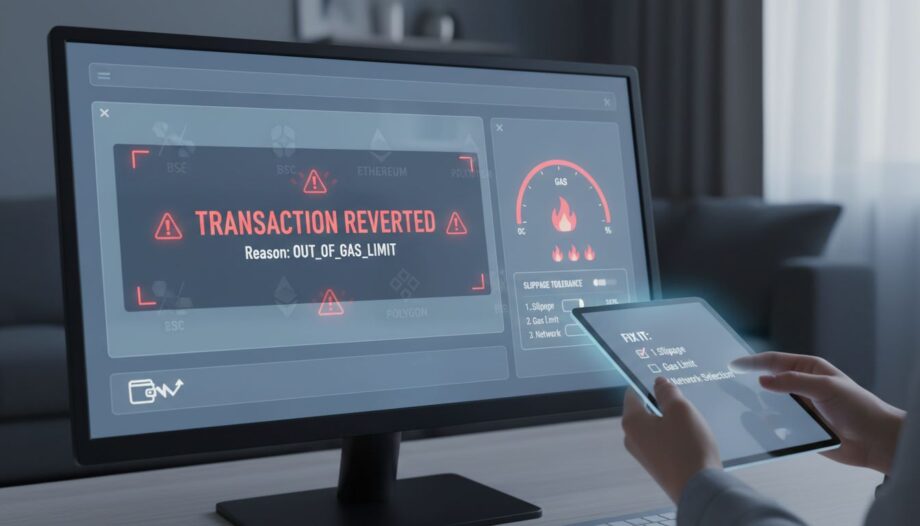
Token swaps represent the fundamental building blocks of decentralized finance, enabling users to exchange one cryptocurrency for another directly through decentralized exchanges (DEXs) or wallet interfaces. These automated market maker protocols facilitate billions of dollars in trading volume daily, yet many users encounter frustrating failures that can cost gas fees without completing the intended trade.
This comprehensive guide explores the technical reasons behind swap failures, from slippage tolerance issues to network congestion, and provides actionable solutions for both novice and experienced DeFi users. Understanding these failure modes and their fixes can save significant costs while improving your overall trading success rate across different blockchain networks.
How Swaps Work Under the Hood (And Where They Can Break)
When you initiate a token swap, your transaction enters a complex pipeline that begins with route calculation and ends with either successful settlement or revert. The process starts when your wallet or DEX interface queries available liquidity pools to determine the best exchange rate, then constructs a transaction that gets broadcast to the network’s mempool where miners or validators pick it up for inclusion in the next block.
During execution, smart contracts interact with liquidity pools to perform the actual token exchange, checking various conditions like slippage limits, available liquidity, and token-specific rules. If any of these conditions fail, the transaction reverts to protect users from unfavorable trades, but the computational work already performed still consumes gas fees.
Transaction reverts occur as protective mechanisms built into DEX protocols, preventing trades that would result in significant losses due to price movements, insufficient liquidity, or technical issues. However, blockchain networks like Ethereum charge gas fees for all computational work, regardless of whether the transaction succeeds or fails, making failed swaps costly mistakes that accumulate over time.
Resource constraints, token-specific logic, and network conditions create numerous failure points throughout this process. Understanding where these breakdowns occur helps traders anticipate problems and adjust their strategies accordingly, reducing both failure rates and associated costs.
From Quote to Transaction: The Swap Lifecycle
The swap lifecycle begins with a quote request, where your interface queries multiple DEXs and aggregators to find the best available rate for your desired trade. This quote includes estimated output amounts, price impact calculations, and suggested slippage tolerances based on current market conditions and liquidity depth.
Route selection follows, with aggregators determining whether to split your order across multiple pools or execute it through a single liquidity source. Once you confirm the trade, your wallet constructs and signs the transaction, broadcasting it to the network where it competes with other transactions for block inclusion based on gas price and network priority.
The distinction between application-level errors and on-chain reverts becomes crucial here, as app errors typically occur before transaction submission and don’t cost gas, while on-chain reverts happen during execution and consume fees even when failing. Understanding this difference helps users identify whether issues stem from interface problems or fundamental blockchain constraints.
Why a Failed Swap Still Costs Gas
Ethereum Virtual Machine (EVM) based chains charge gas fees for computational work performed by network validators, regardless of transaction outcomes. When a swap fails, the smart contract still executes code to check conditions, interact with liquidity pools, and ultimately revert the state changes, all of which requires computational resources that validators must be compensated for providing.
This gas consumption on failed transactions creates hidden costs that many users don’t anticipate, especially when repeatedly attempting swaps with incorrect parameters. Over time, these failed transaction fees can accumulate to substantial amounts, making proper swap configuration essential for cost-effective trading strategies.
Slippage and Price Movement: The #1 Reason Swaps Fail
Slippage occurs when the actual execution price differs from the expected price due to market movements between quote generation and transaction settlement. DEX protocols implement minimum received amount checks to protect users from excessive slippage, automatically reverting transactions when price movements exceed specified tolerances.
The “Insufficient Output Amount” error represents the most common swap failure message, indicating that price movements reduced your expected output below the minimum threshold. This protection mechanism prevents you from receiving significantly fewer tokens than anticipated, but requires careful balance between protection and execution success.
Volatile market conditions, especially during high-impact news events or significant price movements, increase slippage failure rates as prices change rapidly between transaction submission and block confirmation. Understanding these dynamics helps traders adjust their slippage settings appropriately for different market conditions.
Large trade sizes relative to available liquidity create additional slippage through price impact, where your own transaction moves the market against you before completion. This self-induced slippage combines with natural market volatility to increase failure probability, particularly for trades involving smaller or less liquid tokens.
| Scenario | What Happens | Typical Error/Message | How to Fix | Risk Trade-off |
|---|---|---|---|---|
| Low slippage + volatile market | Price moves beyond tolerance | Insufficient Output Amount | Increase slippage to 1-3% | Higher execution cost |
| Large trade size | Price impact exceeds slippage | Price Impact Too High | Split order or reduce size | Multiple gas fees |
| Network congestion delay | Transaction pending too long | Transaction Underpriced | Increase gas price or wait | Higher gas cost or delay |
| Sandwich attack | MEV bot front-runs trade | Slippage Exceeded | Use private mempool or MEV protection | Limited DEX options |
| Stale price quote | Quote outdated by execution time | Quote Expired | Refresh quote before confirming | Miss favorable prices |
How to Adjust Slippage Safely (Without Overpaying)
Start with conservative slippage settings around 0.5% for stable or highly liquid token pairs, then incrementally increase by 0.5% intervals if transactions fail. This gradual approach prevents overpaying while finding the minimum tolerance needed for successful execution under current market conditions.
Monitor price impact separately from slippage tolerance, as high price impact indicates insufficient liquidity rather than market volatility. When price impact exceeds 5%, consider reducing trade size or finding alternative liquidity sources instead of simply increasing slippage tolerance, which won’t resolve the underlying liquidity constraint.
- Test initial swap with 0.5-1% slippage for liquid pairs
- Increase by 0.5% increments if transaction reverts
- Stop increasing if slippage exceeds 5% and reconsider trade size
- Use time-sensitive quotes and execute quickly to minimize staleness
- Consider MEV-protected transactions for high-value trades
- Monitor both slippage tolerance and price impact as separate metrics
Liquidity Problems: When the Pool Can’t Fill Your Swap
Liquidity constraints arise when decentralized exchanges lack sufficient token reserves to fulfill your swap at acceptable prices. Unlike centralized exchanges with order books, DEXs rely on liquidity pools where token availability directly impacts price impact and execution success, making large trades particularly challenging for smaller or newer tokens.
Automated market makers calculate prices using mathematical formulas that create exponential price impact as trades consume larger portions of available liquidity. When your trade would deplete a significant percentage of a pool’s reserves, the resulting price impact can exceed reasonable slippage tolerances, causing transaction reverts even when technically sufficient tokens exist.
Pool depth varies dramatically across different tokens and DEX platforms, with major tokens like ETH and USDC typically offering deep liquidity while newer or niche tokens may have shallow pools prone to high price impact. Understanding these liquidity dynamics helps traders choose appropriate trade sizes and platforms for their specific token pairs.
Fragmented liquidity across multiple DEXs and layer-2 solutions further complicates the landscape, as the same token pair might offer vastly different liquidity depths on different platforms. Aggregators attempt to solve this by splitting orders across multiple sources, but users still need to understand when single large trades become unfeasible regardless of routing optimization.
| Liquidity Issue | How It Shows Up | Price Impact | Best Fix | When to Avoid the Trade |
|---|---|---|---|---|
| Shallow pool depth | High price impact warnings | 5-20% | Reduce trade size by 50-75% | Price impact > 10% |
| New/small token pairs | Limited routing options | 10-50% | Try multiple smaller DEXs | Only 1-2 pools available |
| Imbalanced pool ratios | One-sided liquidity depletion | 3-15% | Wait for rebalancing or arbitrage | Pool ratio > 80:20 |
| Cross-chain fragmentation | Better rates on different chains | 2-10% | Bridge to chain with deeper liquidity | Bridge costs > savings |
| Temporary liquidity drain | Recent large trades depleted pools | 5-25% | Wait 15-30 minutes for arbitrage | Urgent execution needed |
Reducing Swap Size and Splitting Orders
Breaking large trades into smaller chunks reduces price impact exponentially due to the mathematical curves used by automated market makers. A single $10,000 trade might create 8% price impact, while four $2,500 trades might only create 2% impact each, resulting in significantly better overall execution despite paying multiple gas fees.
Time intervals between split orders allow natural arbitrage and liquidity provision to rebalance pools between your transactions. Waiting 10-15 minutes between chunks gives arbitrageurs time to restore favorable pricing, though this strategy requires patience and monitoring to ensure market conditions don’t deteriorate during execution.
The optimal split size depends on pool depth and current liquidity conditions, with most experts recommending keeping individual transactions below 5% of total pool liquidity when possible. Calculate this by dividing your trade size by total pool value and adjusting accordingly, remembering that multiple small successes often outperform single large failures.
Choosing Better Routes and Liquidity Sources
- Compare quotes across multiple aggregators like 1inch, Paraswap, and Matcha rather than relying on single DEX interfaces
- Check layer-2 solutions like Polygon, Arbitrum, or Optimism where the same tokens might offer deeper liquidity at lower costs
- Use professional aggregators that access private liquidity sources and market maker networks for larger trades
- Consider centralized exchange arbitrage opportunities when DEX liquidity proves insufficient for your trade size
- Monitor social sentiment and recent trading activity to identify when tokens have temporary liquidity constraints
- Bookmark multiple DEX interfaces and aggregators to quickly compare routes during volatile market conditions
Network Congestion, Gas Settings, and Timing Issues
Blockchain network congestion creates cascading failures for token swaps as transaction fees spike and confirmation times increase dramatically. During high-demand periods, such as NFT mints, major market events, or protocol launches, networks become overloaded with transactions competing for limited block space, causing swap failures even with correct parameters.
Gas price miscalculations represent a common failure mode where users submit transactions with insufficient fees to achieve timely inclusion in blocks. While the transaction remains technically valid, it sits in the mempool indefinitely as miners prioritize higher-paying transactions, eventually leading to failure as price quotes become stale or market conditions change unfavorably.
Wallet interfaces like MetaMask or Phantom often struggle with dynamic gas estimation during volatile network conditions, suggesting fees that were accurate minutes ago but insufficient for current demand. This creates frustrating scenarios where repeated transaction attempts fail while gas fees accumulate, particularly affecting users unfamiliar with manual gas adjustment techniques.
- Monitor network congestion through gas tracking websites before initiating large or time-sensitive swaps
- Set gas prices 20-50% above current fast estimates during periods of high network activity
- Use transaction replacement features to increase gas prices for stuck transactions instead of submitting duplicates
- Consider alternative layer-1 blockchains or layer-2 solutions during Ethereum network congestion
- Avoid peak usage hours like weekday US market open/close when network activity typically spikes
- Enable automatic gas price adjustment in wallet settings if available for your preferred interface
- Keep separate gas token reserves specifically for fee payments to avoid insufficient balance errors
Practical Gas and Timing Tweaks to Reduce Failures
Implementing strategic gas management starts with understanding your network’s fee market dynamics and setting appropriate priorities for different transaction types. For routine swaps, using standard gas prices during off-peak hours can reduce costs significantly, while urgent trades may justify premium fees to ensure rapid execution.
Transaction timing optimization involves monitoring network patterns and avoiding predictable congestion periods. Most networks experience peak activity during business hours in major financial centers, making early morning or late evening often optimal for cost-effective transactions.
Cancel-and-replace workflows allow you to update stuck transactions rather than submitting duplicates, preventing multiple gas expenditures for the same intended swap. Most modern wallets support this functionality, though it requires understanding nonce management and transaction state tracking to use effectively.
Token-Specific Problems: Fees, Rebases, and Malicious Tokens
Certain token types implement mechanisms that interfere with standard DEX swap logic, creating failures that aren’t immediately obvious to users. Fee-on-transfer tokens automatically deduct percentages during transfers, causing DEX calculations to fail when expected token amounts don’t match actual received amounts after fees are applied.
Rebase tokens adjust their total supply periodically, changing individual wallet balances to maintain target prices or economic policies. These supply adjustments can occur between transaction submission and execution, causing swap calculations to fail when the actual token amount differs from what the DEX smart contract expected based on the original quote.
Malicious tokens represent a growing threat where scam projects implement hidden functions to prevent selling, charge excessive fees, or redirect funds to unauthorized addresses. These “honeypot” tokens appear normal during purchase but reveal their true nature when users attempt to swap them back to other currencies.
Safety tools and contract analysis become essential for identifying problematic tokens before attempting swaps. Community-driven databases, automated scanning services, and manual contract verification help users avoid tokens with unusual behaviors that could cause swap failures or financial losses.
| Token Type/Issue | How It Breaks Swaps | Typical Symptoms | What You Can Do | Risk Level |
|---|---|---|---|---|
| Fee-on-transfer tokens | Automatic fee deduction disrupts calculations | Insufficient output despite correct slippage | Use DEXs with fee-on-transfer support | Medium |
| Rebase tokens | Supply changes alter expected amounts | Balance mismatches during execution | Avoid trading near rebase events | Medium |
| Honeypot tokens | Hidden sell restrictions or excessive fees | Can buy but cannot sell or swap out | Verify contract before trading | High |
| Paused/frozen tokens | Administrative controls block transfers | Transaction reverts with pause error | Wait for unpause or avoid entirely | High |
| Deflationary tokens | Burn mechanisms reduce actual transfers | Lower than expected output amounts | Account for burn rate in slippage | Low |
| Blacklist tokens | Address restrictions prevent transfers | Transfer blocked error messages | Check blacklist status before trading | Medium |
Detecting and Avoiding Scam or Broken Tokens
- Verify token contracts through established scanners like Honeypot.is or Token Sniffer before making any purchases
- Check for excessive transaction fees, hidden sell restrictions, or unusual ownership concentration patterns
- Research the development team, project documentation, and community feedback through official channels
- Test small amounts first before committing significant capital to unfamiliar or newly launched tokens
- Avoid tokens with extremely low holder counts, recent contract deployment, or missing social media presence
- Monitor community warnings on platforms like Twitter, Reddit, or Discord for reports of problematic tokens
- Use established token lists from reputable sources rather than trading random contract addresses
Workarounds for Rebase and Fee-on-Transfer Tokens
When working with fee-on-transfer tokens, use DEXs specifically designed to handle these mechanisms, such as SushiSwap or specialized protocols that account for fee deductions in their calculations. These platforms adjust their smart contract logic to expect reduced token amounts after fees, preventing the calculation mismatches that cause standard DEX failures.
For rebase tokens, timing becomes crucial as supply adjustments typically occur at predictable intervals. Avoid trading immediately before, during, or shortly after known rebase events, and consider using exact input amounts rather than exact output amounts to reduce calculation sensitivity to supply changes.
Alternative approaches include using wrapped versions of problematic tokens when available, or utilizing centralized exchanges that handle these token mechanics at the infrastructure level. While this sacrifices some decentralization benefits, it often provides more reliable execution for tokens with unusual characteristics.
Wallet, Approval, and Balance Issues
Wallet configuration errors create some of the most preventable swap failures, yet they remain common due to the complexity of managing multiple blockchain networks, token approvals, and gas reserves. Users frequently encounter failures when attempting cross-chain swaps while connected to the wrong network, or when insufficient gas tokens remain for transaction fees despite having adequate tokens to trade.
Token approval mechanisms require separate transactions to grant DEX contracts permission to spend your tokens, creating a two-step process that many users don’t fully understand. Inadequate approvals, expired approvals, or approval amounts smaller than intended swap sizes cause transactions to fail even when all other parameters are correct.
Chain selection errors become increasingly common as the multi-chain ecosystem expands, with users accidentally attempting swaps on networks where their desired tokens don’t exist or where liquidity remains insufficient. Modern wallets attempt to prevent these errors through network detection, but manual verification remains essential for reliable execution.
- Verify you’re connected to the correct blockchain network before initiating any swap transaction
- Maintain sufficient gas token reserves separate from trading tokens to cover transaction fees
- Check token approval amounts and refresh approvals if they’ve expired or seem insufficient
- Confirm your wallet displays the correct token balances for the intended trade pair
- Test wallet connectivity with small transactions before attempting large swaps
- Clear browser cache and restart wallet applications if interface errors persist
- Keep wallet software and browser extensions updated to the latest versions for optimal compatibility
Quick Pre-Swap Checklist for Wallet Settings
Before executing any token swap, systematically verify your wallet configuration to prevent common failures. Confirm network selection matches your intended trading pair, check that gas token balances exceed estimated fees plus a safety margin, and ensure token approvals are current and sufficient for your trade size.
Review displayed token balances for accuracy, as outdated cache data can show incorrect amounts leading to insufficient balance errors. If balances appear wrong, refresh the interface or check balances directly through blockchain explorers to confirm actual holdings.
Test wallet connectivity and interface responsiveness with small interactions before committing to large trades. Wallet software issues often become apparent during these preliminary checks, allowing you to resolve problems before they cause expensive failed transactions.
Cross-Chain, Bridge, and Aggregator-Related Failures
Cross-chain swaps introduce additional complexity layers where failures can occur at multiple points throughout the process. Bridge protocols must lock tokens on the source chain, communicate with destination chain contracts, and mint or unlock corresponding tokens, creating numerous opportunities for technical failures, communication delays, or liquidity constraints that don’t exist in single-chain swaps.
Aggregator-related failures occur when routing protocols attempt to optimize trades across multiple DEXs and chains but encounter issues with one component of the complex transaction path. A single failed step in a multi-hop route can cause the entire transaction to revert, often leaving users uncertain about where the failure occurred and whether their funds are safe.
Bridge timing issues create scenarios where transactions succeed on one chain but fail on another, potentially leaving funds temporarily locked or requiring manual intervention to complete transfers. These situations often require specialized troubleshooting knowledge and direct communication with protocol support teams to resolve.
Stuck fund scenarios emerge when cross-chain protocols encounter errors that prevent automatic completion of transfer processes. While funds typically remain safe in protocol-controlled contracts, accessing them may require support tickets, manual processing, or specific recovery procedures unique to each bridge implementation.
| Flow Type | Where It Can Fail | Typical User Experience | Resolution Path | Who to Contact |
|---|---|---|---|---|
| Bridge + DEX combo | Bridge confirmation delays | Tokens disappeared, swap pending | Wait 30+ minutes for bridge finalization | Bridge protocol support |
| Multi-hop aggregation | One DEX in route fails | Partial execution or full revert | Retry with different routing | Aggregator support team |
| Cross-chain arbitrage | Price changes during bridge transfer | Unfavorable execution price | Accept loss or hold tokens | Original aggregator |
| Layer 2 withdrawal | Withdrawal proof generation | Funds locked for challenge period | Wait full challenge period (7 days) | L2 protocol support |
| Intent-based routing | Solver fails to fulfill intent | Transaction timeout or cancellation | Retry or use different protocol | Intent protocol support |
Tracing Where the Funds Are in Complex Flows
When cross-chain or multi-step transactions fail, systematic fund tracing becomes essential for determining next steps and recovery options. Start by examining the source chain explorer to confirm whether your initial transaction succeeded and tokens were properly locked or burned according to the protocol’s mechanism.
Bridge monitoring tools and protocol-specific explorers often provide transaction status information that standard blockchain explorers miss. Many bridge protocols offer dedicated interfaces showing transfer progress, estimated completion times, and any errors encountered during the cross-chain process.
Document all relevant transaction hashes, addresses, and timestamps before contacting support, as this information proves essential for technical teams to locate and resolve stuck transactions. Screenshot error messages and note the exact sequence of actions leading to the failure to expedite resolution processes.
When to Escalate to Support
- Funds have been missing for more than 2 hours in cross-chain transactions with no progress updates
- Bridge interfaces show error states or failed status after multiple refresh attempts
- Transaction succeeded on source chain but destination chain shows no corresponding activity
- Protocol interfaces display conflicting information about transaction status or fund location
- Standard troubleshooting steps like clearing cache, switching networks, or waiting haven’t resolved the issue
Advanced Error Codes and Chain-Specific Gotchas
Blockchain networks generate cryptic error messages that often mask the underlying causes of swap failures, requiring translation into actionable troubleshooting steps. Understanding common error codes like “execution reverted,” “out of gas,” or “insufficient liquidity” helps users quickly identify whether issues stem from slippage settings, gas configuration, or market conditions.
Chain-specific behaviors create additional complexity as different networks implement varying gas models, transaction formats, and smart contract limitations. Ethereum’s high gas costs and congestion patterns differ significantly from Binance Smart Chain’s validator-based system or Polygon’s proof-of-stake mechanics, requiring tailored approaches for each network.
Memory and computational limits vary across networks, with some chains imposing stricter constraints on complex transactions that involve multiple token swaps or cross-contract interactions. These limitations often manifest as mysterious failures for transactions that would succeed on other networks with identical parameters.
Protocol-specific error messages from major DEX implementations like Uniswap, PancakeSwap, or SushiSwap contain valuable diagnostic information when properly decoded. Learning to interpret these messages accelerates troubleshooting and reduces the trial-and-error approach that leads to multiple failed transaction fees.
Decoding Messages Like “Insufficient Output Amount”
The “Insufficient Output Amount” error indicates that price movements between quote generation and execution reduced your expected output below the minimum acceptable amount based on your slippage tolerance. This protection mechanism prevents you from receiving significantly fewer tokens than anticipated, but requires adjustment of either slippage settings or trade timing to resolve.
Begin troubleshooting by checking recent price movements for your token pair through price tracking websites or DEX analytics platforms. If significant volatility occurred recently, the error likely results from legitimate market movement rather than technical issues, requiring increased slippage tolerance or smaller trade sizes.
- Check recent price history for signs of volatility or major market movements
- Increase slippage tolerance incrementally from current setting by 0.5-1% steps
- Refresh the price quote to ensure you’re working with current market data
- Consider reducing trade size if price impact warnings appear excessive
- Verify network congestion isn’t causing delayed execution that allows prices to move
- Switch to a different DEX or aggregator if the error persists across multiple attempts
How Protocol Design Affects Swap Reliability
Different DEX architectures create varying failure patterns based on their underlying mechanisms for price discovery, liquidity provision, and transaction processing. Automated Market Makers (AMMs) like Uniswap rely on mathematical formulas that can create predictable slippage patterns, while order book-based DEXs may fail due to insufficient limit orders at desired price levels.
Mempool exposure represents a critical design choice that affects swap reliability, as transactions visible in public mempools become targets for MEV (Maximal Extractable Value) extraction through front-running and sandwich attacks. These attacks can cause legitimate user transactions to fail by artificially manipulating prices immediately before execution.
Private order flow and offchain matching systems attempt to solve MEV issues but introduce different failure modes related to quote freshness, counterparty reliability, and execution guarantees. Understanding these trade-offs helps users choose appropriate protocols for different transaction sizes and timing requirements.
Intent-based protocols represent an emerging design pattern where users express desired outcomes rather than specific execution paths, allowing solvers to compete for optimal fulfillment. While this can improve execution quality, it creates new failure modes when no solvers can profitably fulfill the stated intent within specified parameters.
| Design Feature | Impact on Failed Swaps | Pros | Cons | What Users Should Watch |
|---|---|---|---|---|
| Public mempool exposure | Vulnerable to MEV attacks causing failures | Full decentralization, transparent | Sandwich attacks, front-running | Unusual slippage patterns |
| Private order flow | Reduced MEV but centralization risks | Better execution, MEV protection | Centralized points of failure | Service availability status |
| Intent-based matching | Fails when no solver can fulfill | Optimal execution, gas efficiency | Complexity, solver dependency | Solver competition levels |
| Gasless transactions | Relayer failures prevent execution | User-friendly, no gas needed | Relayer centralization, delays | Relayer network health |
| Cross-chain aggregation | Multiple failure points in complex routes | Best rates, liquidity access | Complexity, bridge risks | Bridge and route stability |
Mempool Exposure, MEV, and Sandwich Risk
Maximal Extractable Value (MEV) refers to profit opportunities that validators or miners can capture by reordering, including, or censoring transactions within blocks. For token swaps, this often manifests as sandwich attacks where MEV bots place transactions before and after your swap to extract value from the price impact you create.
Sandwich attacks work by front-running your transaction with a purchase that increases the token price, then back-running with a sale after your transaction executes at the inflated price. This manipulation can cause your transaction to fail due to excessive slippage or result in significantly worse execution prices than expected.
Mitigation strategies include using DEXs with MEV protection, setting conservative slippage tolerances that account for potential manipulation, or utilizing private mempools that prevent bots from seeing your transactions before execution. Some protocols offer specific protection mechanisms, though these often involve trade-offs in terms of speed or available liquidity sources.
Gasless and Offchain Swaps: Different Failure Behaviors
Gasless transaction protocols rely on relay networks where third parties submit transactions on your behalf after you sign them off-chain. These systems can fail when relayers experience technical issues, run out of gas funds, or encounter network congestion that makes transaction submission unprofitable for the relay operators.
Request-for-Quote (RFQ) systems allow market makers to provide firm prices for specific trade sizes, but these quotes typically expire quickly and can fail if you don’t execute within the specified time window. Unlike AMM failures that revert on-chain, RFQ failures often occur before any blockchain interaction, avoiding gas costs but potentially missing favorable market opportunities.
Offchain matching systems introduce counterparty risk where the entity promising to fulfill your swap might fail to deliver due to technical issues, liquidity constraints, or business decisions. While these systems often provide better execution prices, they require trust in the counterparty’s ability and willingness to honor their commitments.
Step-by-Step Troubleshooting Playbook for Failed Swaps
Systematic troubleshooting prevents wasted time and gas fees while ensuring you address the most likely causes of swap failures first. This methodical approach helps identify whether issues stem from user configuration, market conditions, or technical problems with the underlying protocols.
Begin every troubleshooting session by documenting the specific error messages, transaction hashes, and exact parameters used for the failed swap. This information becomes crucial if you need to escalate to protocol support teams and helps you avoid repeating the same mistakes in future attempts.
The following playbook addresses failure causes in order of frequency and ease of resolution, allowing you to solve common issues quickly while building toward more complex diagnostic procedures for unusual problems.
- Record exact error messages and transaction details for future reference
- Check slippage tolerance settings and increase by 0.5-1% if price volatility is high
- Verify gas settings are adequate for current network congestion levels
- Confirm wallet balance includes sufficient tokens plus gas reserves for the transaction
- Test alternative routing through different DEXs or aggregators to isolate protocol-specific issues
- Reduce trade size by 25-50% to minimize price impact and liquidity constraints
- Wait 10-15 minutes and retry if network congestion or temporary liquidity issues are suspected
- Escalate to protocol support with documented transaction details if problems persist after systematic troubleshooting
Preventing Future Failures: Best Practices Checklist
Developing consistent habits around swap execution significantly reduces failure rates and associated costs. These practices become particularly valuable during volatile market conditions when failure rates typically increase due to rapid price movements and network congestion.
Regular maintenance of wallet settings, approval management, and gas token reserves prevents many common failure modes. Staying informed about network conditions and protocol updates helps you anticipate and avoid temporary issues that might affect swap reliability.
| Best Practice | What It Prevents | How Often to Do It | Risk if Ignored |
|---|---|---|---|
| Monitor gas prices before trading | Underpriced transactions and delays | Before each session | Failed transactions, stuck funds |
| Keep gas reserves separate from trading funds | Insufficient balance for transaction fees | Weekly balance checks | Cannot execute trades |
| Test small amounts on unfamiliar tokens | Large losses to scam or broken tokens | First interaction with new tokens | Total loss of invested funds |
| Update wallet software regularly | Compatibility issues and security vulnerabilities | Monthly or when prompted | Interface errors, security risks |
| Verify network selection before trading | Wrong chain errors and failed transactions | Every transaction | Wasted gas fees |
| Compare quotes across multiple aggregators | Poor execution prices and failed routes | For trades over $1000 | Suboptimal pricing |
| Set realistic slippage for market conditions | Repeated transaction failures | Adjust based on volatility | Multiple failed transaction fees |