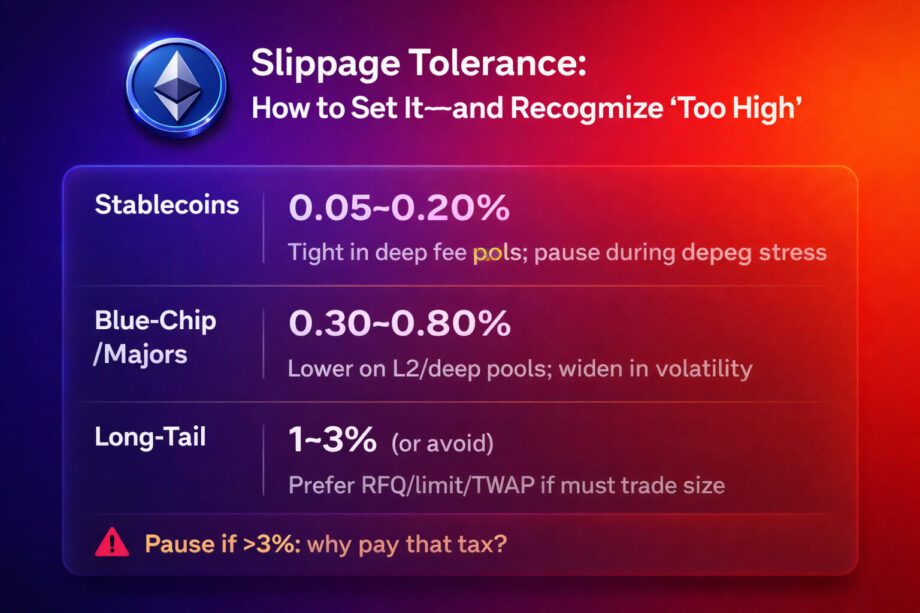
Slippage Tolerance: How to Set It—and Recognize “Too High”

What is slippage in a crypto swap and why does it matter for business? Slippage is the hidden execution cost in a swap: the difference between the price you were shown and the price you actually receive. If you’re running payments or treasury flows, that gap can quietly eat margin and create P&L noise—especially when you repeat the same swaps […]

DEX Aggregator or Direct Swap: The Smarter Execution for Your Trade

What are DEX aggregators vs direct DEX swaps? DEX aggregators typically deliver better execution than swapping on a single DEX, but they add another layer—and its risks. Why? Liquidity is fragmented across Uniswap, SushiSwap, Curve, Balancer, and more. Aggregators like 1inch, Matcha, ParaSwap, and CoW Swap route across pools to cut slippage, split orders, and sometimes tap RFQ quotes from […]

When to swap on-chain vs on a centralized exchange

When deciding where to swap crypto, traders face a fundamental routing choice: execute swaps directly on-chain through decentralized exchanges and aggregators, or route through centralized exchanges with their order books and custodial systems. Both paths achieve the same goal of converting one asset to another, but they differ dramatically in custody requirements, fee structures, liquidity access, KYC compliance, and regulatory exposure.

The truth about liquidity pools and who controls them

When you hear about DeFi liquidity pools, the marketing narrative often paints a picture of "fully decentralized liquidity" where users maintain complete control over their assets. The reality is far more nuanced, involving complex layers of smart contract control mechanisms, governance tokens with concentrated voting power, and admin keys that can override user preferences. Understanding who actually controls these pools is crucial for anyone considering depositing capital into DeFi protocols.

What to check before swapping exotic tokens

Exotic tokens represent the wild frontier of decentralized finance—new launches with tiny market caps, experimental projects with unproven mechanics, and assets so fresh they barely register on mainstream platforms. These digital assets often promise revolutionary technology or eye-watering yields, but they carry risks that can obliterate portfolios in minutes. Unlike established cryptocurrencies with deep liquidity and battle-tested smart contracts, exotic tokens frequently operate with unaudited code, anonymous development teams, and razor-thin trading volumes.

Why some swaps fail and how to fix it

Token swaps represent the fundamental building blocks of decentralized finance, enabling users to exchange one cryptocurrency for another directly through decentralized exchanges (DEXs) or wallet interfaces. These automated market maker protocols facilitate billions of dollars in trading volume daily, yet many users encounter frustrating failures that can cost gas fees without completing the intended trade.

How to avoid being sandwich attacked on DEXs

Many DeFi traders discover mysterious losses in their DEX swaps without realizing they've fallen victim to sophisticated MEV bots. These automated sandwich attacks silently extract value from unsuspecting users through front-running tactics on automated market makers, often resulting in substantially worse execution prices than expected.

Why your swap price changes at the last second: slippage explained

Picture this: you're about to swap 1 ETH for what the interface promises is 2,800 USDC on your favorite DEX. You confirm the transaction, wait through the network confirmation, and suddenly you're holding just 2,712 USDC instead. That missing $88 didn't vanish into thin air—it disappeared into slippage, the silent tax on every crypto swap that catches traders off guard when prices shift between the moment you click "swap" and when your transaction actually executes on-chain.