
What is slippage in a crypto swap and why does it matter for business?
Slippage is the hidden execution cost in a swap: the difference between the price you were shown and the price you actually receive. If you’re running payments or treasury flows, that gap can quietly eat margin and create P&L noise—especially when you repeat the same swaps every day or week. Paying an extra 1–2% on each conversion doesn’t feel dramatic once, but it compounds fast.
On AMMs like Uniswap v3 and Curve, slippage comes from the mechanics of liquidity pools: the larger your trade compared to available liquidity, the more the pool price moves against you. Thin liquidity, volatile tokens, and long-tail assets amplify this effect. On aggregators and order-book style venues, you still face slippage, just through different channels: shallow market depth, imperfect routing, slow settlement, sudden gas spikes, and MEV/front-running that changes the execution path between quote and confirmation.
For a business, the problem isn’t only “bad fills.” It’s that slippage distorts unit economics. Invoiced amounts can become less predictable, treasury rebalancing can underperform benchmarks, and ROI calculations can look great in planning but drift in execution. If the goal is to reduce dependence on bank spreads, you still need discipline around on-chain execution.
Mitigation is mostly about controlling uncertainty. Keep tolerances tight enough to block obvious overpaying and MEV, but not so tight that you constantly revert and burn gas. Use deeper pools when possible (stablecoin and stable-swap liquidity is often more forgiving), and if you’re moving size, split execution over time with TWAP-style slicing or use RFQ/OTC quotes that give you firmer prices. It also helps to simulate routes before signing and to run simple post-trade measurement—treat slippage like a cost line item, not a rounding error.
How do AMMs like Uniswap, Curve, and PancakeSwap create slippage during swaps?
Slippage happens because AMMs reprice along bonding curves. Your order moves the market, and shallow liquidity + volatility + MEV can turn a quote into a worse fill.
Why does a large swap slip?
In constant-product AMMs (x*y=k), price impact grows with order size relative to pool depth. Curve reduces slippage for stables using a stable-swap invariant, but if pools get imbalanced (depegs, big outflows), slippage spikes. PancakeSwap follows similar mechanics on BNB Chain, with added effects from gas swings and liquidity fragmentation.
MEV makes it worse
Front-running/sandwiching and gas spikes can widen effective slippage beyond your tolerance. Who pays? You—via margin.
How do I estimate the right slippage tolerance before I click swap?
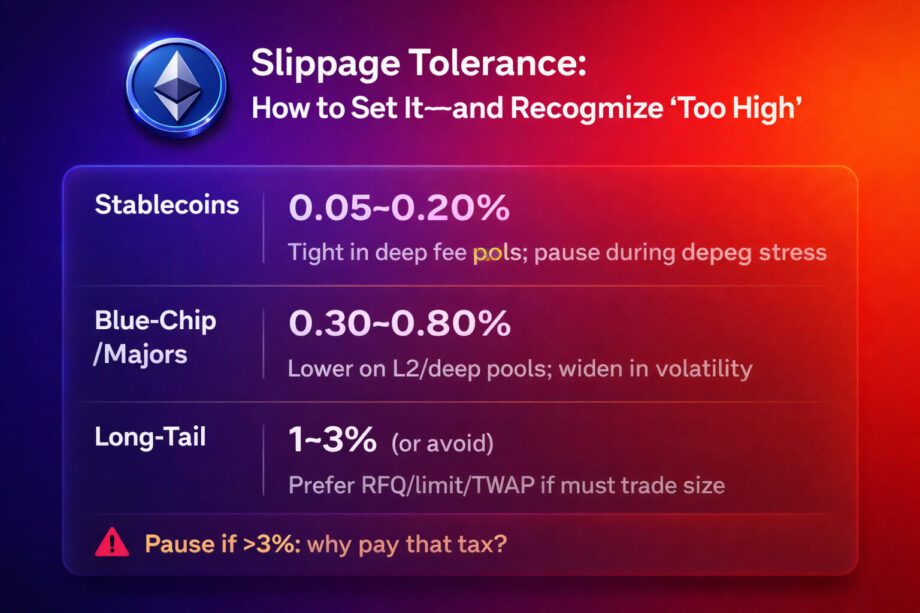
A good tolerance is a tradeoff between two failures: setting it too tight causes reverts and wasted gas, while setting it too loose guarantees you’ll overpay and invites MEV. For major pairs in deep liquidity—ETH, WBTC, and common stablecoin routes—tolerances are often comfortably tight, roughly in the 0.05–0.30% range. For mid- and long-tail tokens, 0.5–2% is more typical, and anything above ~3% should trigger a pause and a “why is this so expensive?” check.
Before you decide, anchor on trade size relative to liquidity. If your swap is a meaningful chunk of what’s available at the active price range (especially on Uniswap v3, where liquidity can be concentrated), your price impact will rise quickly. If volatility is spiking in the last few minutes, quotes degrade faster and you either widen tolerance slightly or wait. Route quality matters too: venues that use RFQ/intent style execution or batch auctions can reduce MEV exposure, so you can often keep tolerances tighter than you would on a simple public-pool swap. Deadlines also matter—shorter deadlines reduce drift between quote and inclusion.
| Asset type | Typical tolerance | Notes |
|---|---|---|
| Stablecoins | 0.05–0.20% | Tight in deep pools; pause during depeg stress |
| Blue-chips (ETH/WBTC) | 0.30–0.80% | Lower on L2/deep pools; higher in volatility |
| Long-tail tokens | 1–3% (or avoid) | Prefer RFQ/limit/TWAP if you must trade size |
When is slippage “too high” for a corporate treasury or payment workflow?
It’s too high when total execution cost (slippage plus fees plus gas plus MEV risk) starts to erase the business case. For payments and common settlement pairs, companies often target very low basis-point costs; if you’re consistently seeing wider slippage on majors, it’s usually a sign you should change venue, routing, timing, or order style. For treasury rebalancing, acceptable slippage tends to be higher because sizes are larger and tradeoffs are different, but it should still be benchmarked against TWAP/VWAP-style execution or alternative liquidity sources.
The clean way to define “too high” is policy-driven: tie maximum slippage to gross margin, risk appetite, and the savings you expect versus traditional rails. If the all-in cost is approaching what you were trying to avoid (like card rails at ~2–3% or unfavorable FX spreads), the trade no longer serves the goal.
What execution tactics reduce slippage and MEV risk?
The biggest improvements come from three levers: picking the right venue, controlling how you reveal the order, and controlling trade size over time. MEV-resistant execution (batch auctions, private orderflow, or RFQ-style fills) helps because it reduces the opportunity for sandwiches and often gives you firmer pricing. Splitting size into smaller clips reduces price impact, though you balance that against gas. Choosing deeper liquidity routes—especially stable pools for stable conversions—usually beats forcing size through thin pools.
For a business workflow, the “adult version” is measurement plus guardrails: simulate before signing, cap slippage per asset, pre-fund execution wallets so gas delays don’t worsen fills, and run post-trade analysis so you can spot when market conditions or routing changes are increasing costs. Over time, this turns slippage from a surprise into a controllable input.
Should I use a DEX, a DEX aggregator, an RFQ/OTC desk, or a CEX for this swap?
| Option | Best for | Why you’d pick it | Watch-outs |
|---|---|---|---|
| Direct DEX (e.g., Uniswap, Curve) | Smaller swaps on common pairs, simple on-chain settlement | Simple flow, fewer moving parts, fewer approvals/routers | Public mempool exposure (MEV), may miss best routing if liquidity is fragmented |
| DEX Aggregator (e.g., 1inch, Matcha/0x, ParaSwap, CoW Swap) | Medium swaps, fragmented liquidity, better routing/MEV tools | Splits routes across pools, can reduce slippage, sometimes adds RFQ/intent or batch auctions for MEV resistance | More complexity and contracts, sometimes higher gas; quality depends on routing + settings |
| RFQ / OTC desk | Large size, firm pricing, predictable execution | Competitive quotes, lower market impact, often better for guaranteed fills | Onboarding/KYC, counterparty/process risk, settlement terms matter |
| CEX (e.g., Coinbase, Kraken) | Fiat ramps, fast execution, audit-friendly ops | Deep order books on majors, fast fills, clean reporting | Custody/withdrawal risk, withdrawal delays/limits, operational controls needed |
Pick the venue that matches your trade size, urgency, and compliance needs, then judge it by all-in execution cost, not the headline quote. For smaller swaps on common pairs, a direct DEX trade can be the simplest path: you get instant settlement and full self-custody, especially on L2s where gas is low. The tradeoff is that public-pool execution can be more exposed to MEV and may not find the best liquidity if it’s fragmented.
If you’re not sure where liquidity lives—or you’re trading a pair that routes better through multiple pools—an aggregator is usually the practical default. Aggregators can improve net execution by splitting across pools and, in some cases, using RFQ/intent-style fills that reduce MEV and quote uncertainty. The downside is added complexity: more contracts, more routing steps, and sometimes higher gas. The key question is simple: does the improvement in price and slippage outweigh the added overhead and risk for this specific trade?
How do I schedule and split swaps (TWAP/VWAP) to control slippage and gas costs?
If you need to trade size without moving the market, TWAP/VWAP-style execution is the standard approach. Instead of doing one big swap that pushes price against you, you break it into smaller clips and execute across time. The goal is to blend into normal market flow so you reduce price impact while keeping execution predictable.
Start by defining what “good execution” means for the workflow: are you hedging exposure, converting incoming revenue, or rebalancing a treasury target? That answer determines whether you care more about speed, minimizing slippage, or minimizing operational complexity. Then set an execution window that matches your risk tolerance. A tighter window reduces exposure to price changes but increases per-slice urgency; a longer window reduces impact but increases market risk while the strategy runs.
From there, choose the venue that best matches your constraints. On-chain, TWAP works best where fees are low (often L2s) and liquidity is deep enough for your clips. Off-chain, VWAP execution on a CEX or via an OTC desk can be more efficient for very large sizes because you avoid on-chain gas entirely and you can work the order through deeper books. Many teams end up using a hybrid: source liquidity off-chain for the heavy lift and settle on-chain when needed.
The practical knobs are: clip size, time interval, maximum slippage per clip, a gas ceiling, and clear pause/kill rules. You don’t want the strategy blindly firing during a volatility spike or a sudden gas surge. You also want execution wallets funded ahead of time so you’re not waiting on transfers while the market moves. And if MEV risk is material, you route through private order flow or MEV-resistant mechanisms so slicing doesn’t simply create more opportunities for extraction.
Over time, the biggest improvement comes from measuring outcomes. Track realized slippage versus a benchmark (like a simple mid-price or a VWAP reference), and treat deviations as something you investigate and fix—route selection, timing, clip size, or venue choice. When you do this consistently, TWAP/VWAP becomes less of a “trading tactic” and more of a reliable operational process.
What governance, controls, and reporting keep slippage within policy?
The cleanest way to control slippage is to remove discretion and make it policy-driven. That starts with explicit limits per asset and per workflow—payments usually want tighter limits than discretionary treasury trades—and then enforcing those limits automatically wherever execution happens.
On the front end, that means pre-trade checks that prevent an operator (or a script) from trading into thin liquidity or during stress conditions without explicit override. On the execution side, it means whitelisting venues, using default MEV protection where possible, capping approvals/spend, and setting guardrails on gas and slippage so a single bad block doesn’t turn into a costly mistake. For larger flows, it also means segregation of duties: the person who requests a trade shouldn’t be the only person who can execute and approve it.
Reporting matters because it turns “we think we’re fine” into evidence. Post-trade analysis should show what you expected, what you got, and why they differed. Even lightweight transaction cost analysis—realized price versus a benchmark, plus gas and failure rates—will surface patterns like “this route is consistently worse,” “we trade during low-liquidity hours,” or “MEV losses spike when we use public mempools.” Once you can see those patterns, you can fix them with routing rules, execution scheduling, or by shifting volume to RFQ/OTC for size.
Finally, auditability isn’t just for auditors—it’s operational safety. Clear logs of who executed what, when, under which limits, and with what outcomes reduces the chance of silent drift and makes it easier to explain results to finance, risk, and leadership. If you’re using crypto to gain flexibility and independence, these controls are what prevent that flexibility from turning into accidental cost.